Walkthrough
One grant, followed all the way round
A demonstration we built with Point North in mind. The foundation is real; the donors, groups, staff and figures are invented. Send an update as a community group, then follow one that has already been approved from the review queue to a donor's feed, the public fund page and the trustees' board pack, signing into each seat as you go.
About ten minutes, in this order
Each seat opens in the same tab. Use your browser's back button, or the walkthrough link in the footer, to come back and take the next one.
- 1. The group: Coast Road Community Kitchen
Five minutes on a phone, in their own words
Coast Road Community Kitchen serves warm meals on a grant from the Point North Community Fund. You play the group: when an update is due, the organiser gets a personal link by text or email. There is no account, no password and no form to download. Harbour Youth Project's update, which you will meet in the next seats, went round the same loop earlier.
What to notice. The draft saves as they go, the three questions are in plain words, and the group decides who may see it before anything is sent.
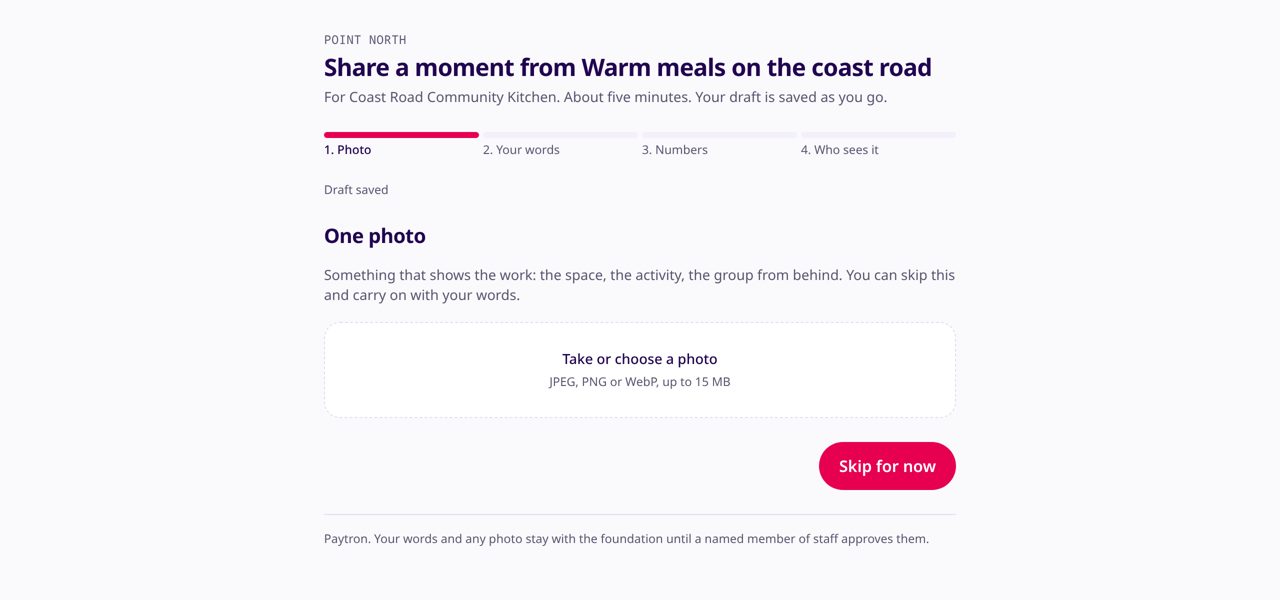
What the youth worker sees: four short steps, a saved draft, and the promise that nothing leaves the foundation until a person approves it. - Open the link on a phone. It works on that one device and expires after seven days.
- Add a photo or a short video, or skip it and just send words.
- Answer three questions in plain words, or dictate them and let Paytron tidy the transcript.
- Give the numbers they counted, in the labels the foundation set.
- Choose who may see it: staff only, the fund's holders, the donors who funded it, or the public.
- 2. The grants officer: Sam Okafor
A review that takes minutes, not evenings
Sam sees the group's words beside a suggested headline and summary, with anything flagged for safeguarding held at the top. Nothing reaches a donor until Sam, or a colleague, approves it and puts a name to it.
What to notice. Words the AI added that are not in the group's answers are highlighted, so Sam checks those rather than reading past them. A held update cannot publish on its own.
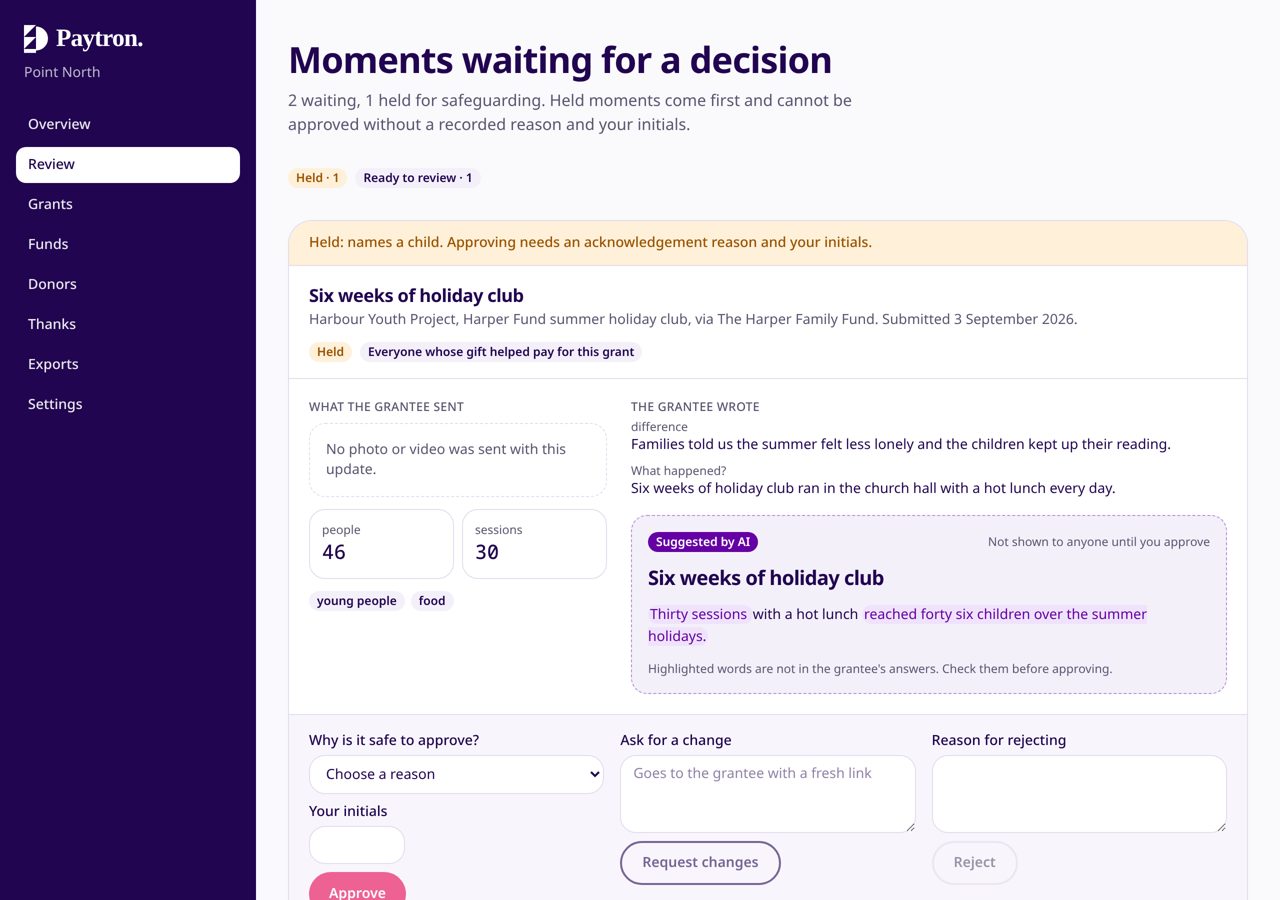
A held update at the top. The suggested summary sits beside the group's own words, with anything the AI added highlighted for checking. - Open the review queue. A held update sits at the top; the one you just sent, if you sent it, is below it.
- Read the group's words, the suggested summary and the consent level side by side.
- Approve it, send it back with a note asking for a change, or hold it.
- If it is flagged, acknowledge the flag and record a reason before deciding.
- Resend a link to a group whose link has expired, from the grants page.
- 3. The donor: Alice Harper
Her share, that grant, those words
Alice gave to the Point North Community Fund and holds the Harper Family Fund. Her feed shows only the grants her gifts reached, with the exact pounds and percentage, and the approved update from Harbour Youth Project appears there with no newsletter in between.
What to notice. The share is worked out to the penny and explained in plain English. She can say thank you (Erin reads it first) and give again with Gift Aid in two taps.
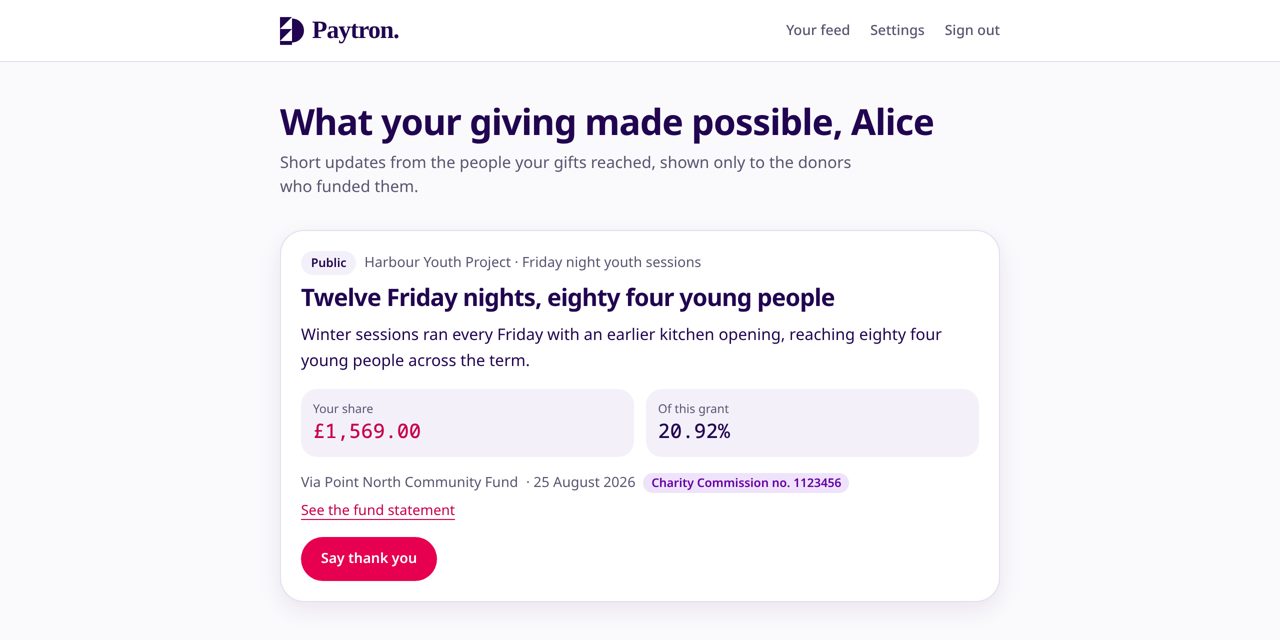
Alice's feed: the grant, the group's words, and her share of it worked out to the penny. - Read the feed: each update names the fund, the grant and her share of it.
- Open a fund statement to see the living figures, signed off by finance.
- Say thank you to the group, then see it wait for a staff check rather than go straight out.
- Give again from the give page, with Gift Aid handled at the point of giving.
- In settings, switch to a monthly round up, download her data or close the account.
- 4. The philanthropy team: Erin Doyle
Every donor stewarded, not just the largest ten
Erin looks after donors and funds. The routing is automatic, so her time goes on the relationships: reading the thank you messages donors send, keeping fund and donor records tidy and spotting who has gone quiet.
What to notice. The donors directory shows gift totals, last gift, cadence and Gift Aid status in one table, and the thank you queue is a check rather than a task.
- Open the donors directory and sort by last gift.
- Open the funds directory to see every fund, its type and its balance.
- Review Alice's thank you message and approve it, so it reaches the group.
- 5. The finance team: Colin Pratt
Figures that reconcile, exports that just work
Colin owns the figures that appear on fund statements and the exports auditors and HMRC ask for. Nothing is published until he signs a period, and every grant payment's shares sum to the payment to the penny.
What to notice. The 360Giving file validates against the standard, the Gift Aid schedule is in HMRC's layout, and the board pack narrative is a draft a named person edits before it leaves.
- Open the exports page and pick a quarter.
- Download the 360Giving file and the Gift Aid claim.
- Generate the quarterly board pack, edit the suggested narrative and approve it.
- 6. The administrator: Nadia Reid
The whole loop on one screen, in your own voice
Nadia runs Point North on Paytron day to day. The overview tells her how long the loop takes to close, how many grants have an update, and which grants have gone silent, and settings put the foundation's own words on every message a donor or group receives.
What to notice. Median days to close the loop, coverage and silent grants are the three numbers a board asks for. The demonstration holds a handful of grants, so the figures move a lot when you approve one. Every change Nadia makes lands in the audit log.
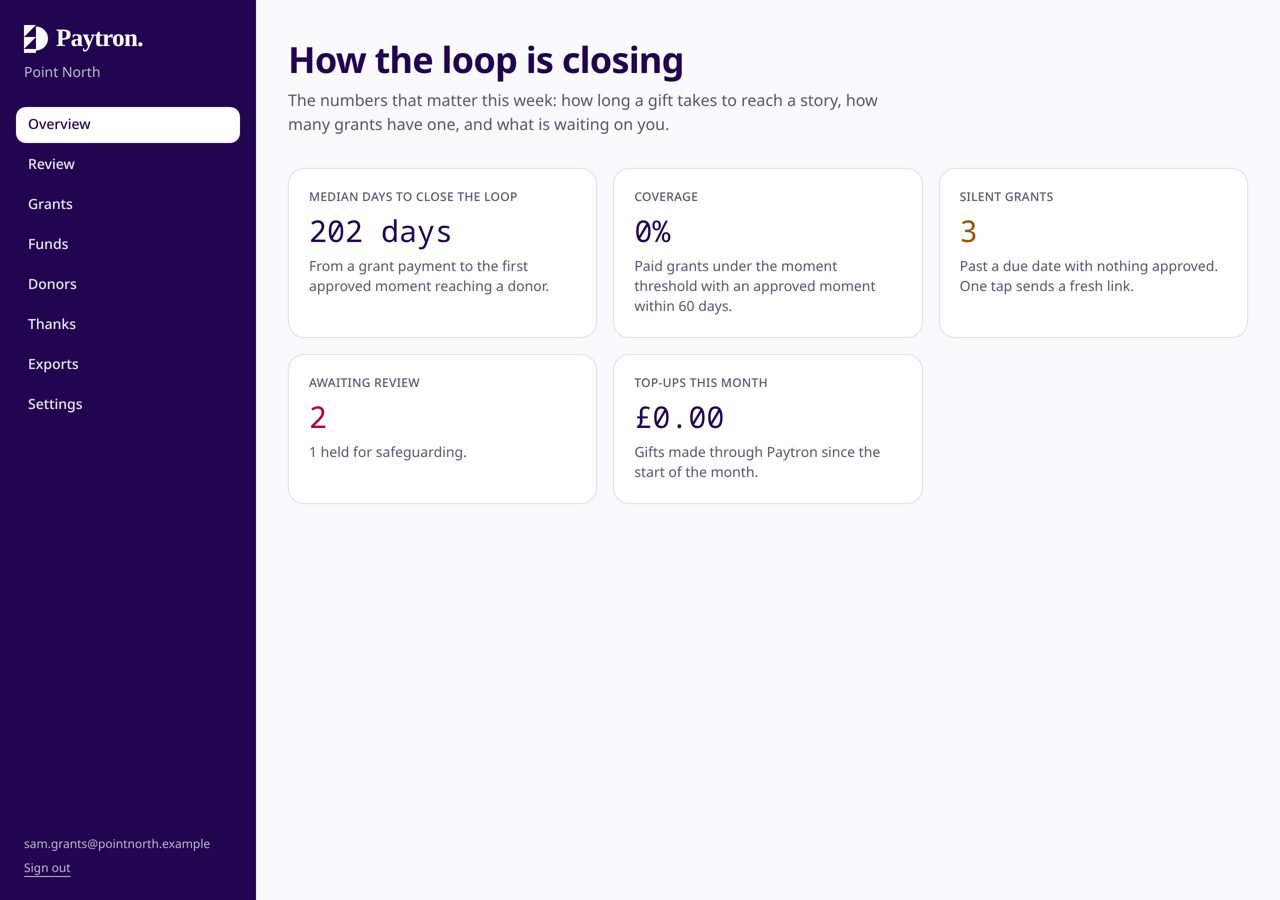
The overview: how long the loop takes to close, how many grants have an update, and which grants have gone quiet. - Open the overview: loop closure, grant coverage, silent grants and the review queue.
- Open settings to see branding, the update questions and the email wording.
- Invite a colleague, change a role or revoke access.
- Check the audit log to see who did what and when.
- 7. The trustee: Tessa Blake
Evidence the foundation does what it promises donors
Tessa can read the overview and the board pack and cannot change anything. What she sees is the case for the foundation in the donors' own terms: money in, grants out, and what happened next, in the groups' words.
What to notice. Everything is read only, so click anywhere.
- Open the overview for the headline numbers a board cares about.
- Open the latest board pack.
- 8. The public: the fund page
A living page for every fund, to send to the next donor
Anyone can open the Point North Community Fund page. It shows what the fund is for, the signed-off figures the foundation chose to publish, the updates groups agreed to make public, and a way to give. It can be embedded on the foundation's own website.
What to notice. Harbour Youth Project chose public, so their update is here. The Pantry chose donors only, so theirs is not. The page enforces that, not a person remembering.
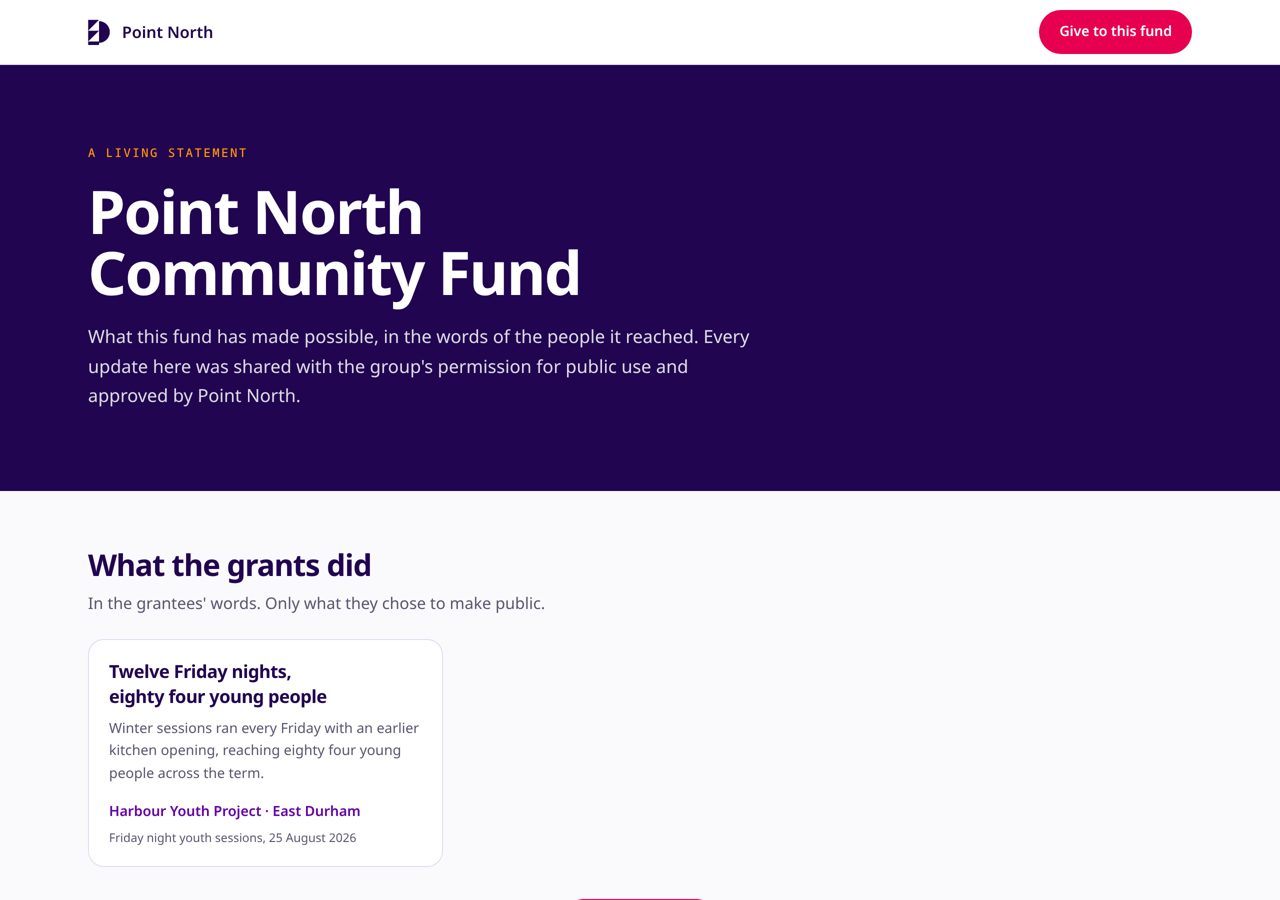
The public fund page. Only updates a group agreed to make public appear here. - Open the public fund page and read what the fund supports.
- Compare it with Alice's feed: same grant, different audience, different content.
Now the same thing with your funds
Send us a week of your CSV export and we load it, so the next walkthrough is your funds, your grants and your donors' shares. No migration and nothing to install.
Every donor, group, member of staff, gift and update in this walkthrough is invented. Nothing here describes a real person, a real grant or Point North's real figures.